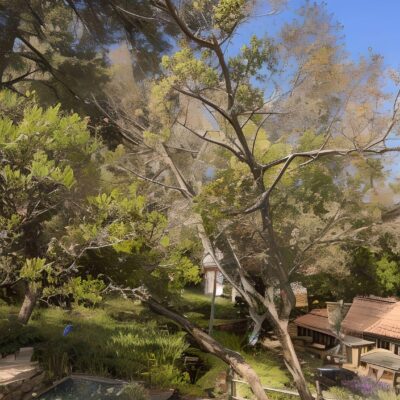
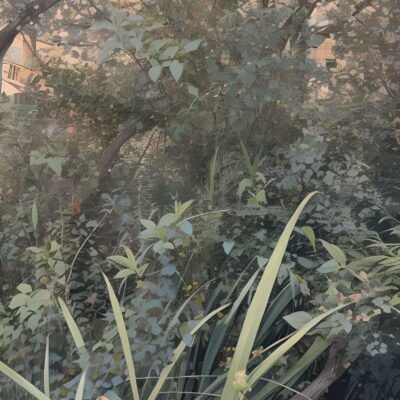
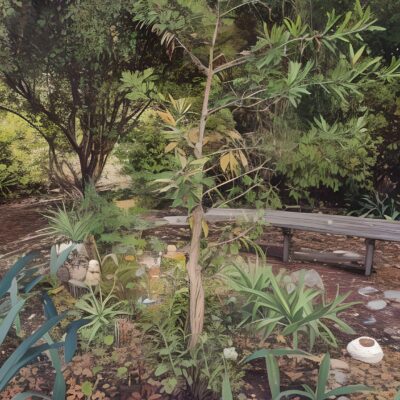
The White Stinkwood tree grows in various habitats, from forests to grasslands. It has light green leaves and small, round fruits. Interesting fact: Despite its name, the White Stinkwood does not have an unpleasant smell and is valued for its wood.
—
Die Witstinkhoutboom groei in verskillende habitats, van woude tot grasvelde. Dit het liggroen blare en klein, ronde vrugte. Interessante feit: Ten spyte van sy naam het die Witstinkhout nie ‘n onaangename reuk nie en word as waardevolle hout beskou.

Trees-Bome
witstinkhout – white stinkwood
Description
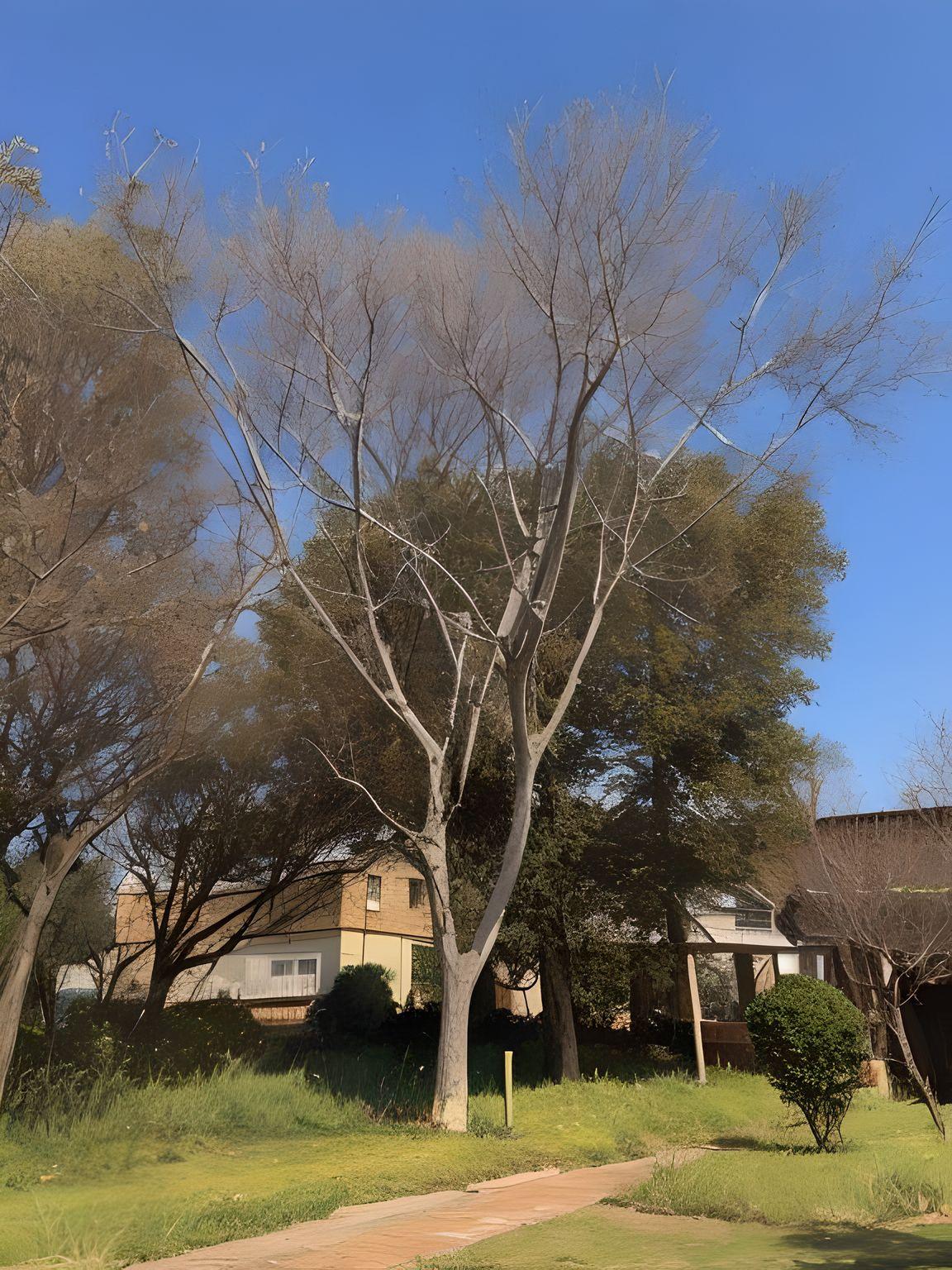
This beautiful deciduous tree grows up to 25 m tall in a forest habitat, but in a garden it can be treated as a medium-sized tree, expected to reach a height of up to 12 m. In the wild, where it is growing in an exposed, rocky position it may be nothing more than a shrub,but well-grown specimens will have a single, straight bole branching to form a dense, semi-circular canopy.
The trunk of Celtis africana is easy to distinguish by its smooth, pale grey to white bark. It may be loosely peeling in old trees and sometimes has horizontal ridges.
In spring Celtis africana is very lovely, with its light green, tender new leaves that contrast beautifully with the pale bark. The leaves are simple, alternate, triangular in shape with three distinct veins from the base, and the margin is toothed for the upper two-thirds. The new leaves are bright, fresh green and hairy, turning darker green and becoming smoother as they mature.
The flowers appear in spring (August to October). They are small, greenish, star-like and inconspicuous. Separate male and female flowers are produced on the same tree. A cluster of male flowers is borne at the base of the new leaf, and the female or bisexual flowers are in the axils of the leaves. The flowers are pollinated by bees. Masses of small, rounded, berry-like fruits on 13 mm long stalks follow the flowers, from October to February. When they turn yellow-brown to black they are ripe.
Distribution and habitat
Celtis africana is common and widespread in South Africa. It occurs in a wide range of habitats from the coast up to 2 100 m, from the Cape Peninsula northwards through South Africa to Ethiopia, where it grows in dense forest, on rocky outcrops, in bushveld, in open grassland, on mountain slopes, on coastal dunes, and along river banks and in kloofs.
Derivation of name and historical aspects
The genus name Celtis is the Latin name used by Pliny, and is also the ancient Greek name for one of the plants reputed to be the lotus of the ancients. The specific epithet africana means African. Celtis africana thus means the African celtis.
C. africana is commonly known as white stinkwood because of the unpleasant smell of the freshly cut wood and its pale colour. It is very unfortunate that it has this common name as it causes confusion with the true stinkwood, Ocotea bullata. These two species do not look similar, nor are they closely related. Ocotea bullata belongs in the Laurel Family (Lauraceae).
The genus Celtis contains about 50 species widely spread throughout the warm temperate regions of the world. Only three species are indigenous to southern Africa namely Celtis gomphophylla (false white stinkwood), C. mildbraedii (Natal white stinkwood) and C. africana. Other related species in southern Africa include Trema orientalis (trema/pigeon wood), Chaetachme aristata (chaetachme/false white pear) and the three celtis species. The genus Celtis is related to the Elm Family (Ulmaceae), which is distributed mainly in the north temperate regions of the world.
Celtis africana closely resembles and can be easily confused with Trema orientalis. Trema is not as widely distributed, nor as tolerant of tough conditions as C. africana. Also, Trema leaves tend to be larger and more slender, serrated nearly from the base, and the female flowers and fruits are carried on much shorter stalks than those of C. africana. Furthermore, related exotic species, C. australis (nettle tree), C. sinensis (Chinese hackberry) and Ulmus parvifolia (Chinese elm), are cultivated in gardens in South Africa and do occasionally escape into natural areas where they may be confused with the indigenous species.
Ecology
Many birds like rameron pigeons, willow warblers, black-eyed bulbuls, mousebirds and crested barbets feed on the fruits and disperse the seeds.
Celtis africana leaves are browsed by cattle and goats, and are food for the larvae of the long-nosed butterfly.
Uses
The wood of Celtis africana is white to yellowish in colour and of medium hardness. It is tough and strong, and polishes well, but is difficult to work. It is a good general timber suitable for making planks, shelving, yokes, tent-bows and furniture. The African people have always used it to make a variety of household articles. It is also thought to have magical properties. The wood is mixed with crocodile fat as a charm against lightning, and many people believe that it has the power over evil and that pegs of wood driven into the ground will keep witches away.
The timber of C. africana has no commercial value.
Related products
-
Trees-Bome
sandolien sand olive
-
Trees-Bome
blinkblaar-africandogwood
-
Trees-Bome
witkaree-white karee
-
Trees-Bome
opregte geelhout real yellowwood